
Most AI tools are good at answering individual questions. Real organizations need something more: systems that understand responsibilities, retain context, work with documents, run recurring processes, produce usable outputs, and know when a human must make the final decision.
Qobri is designed for that gap.
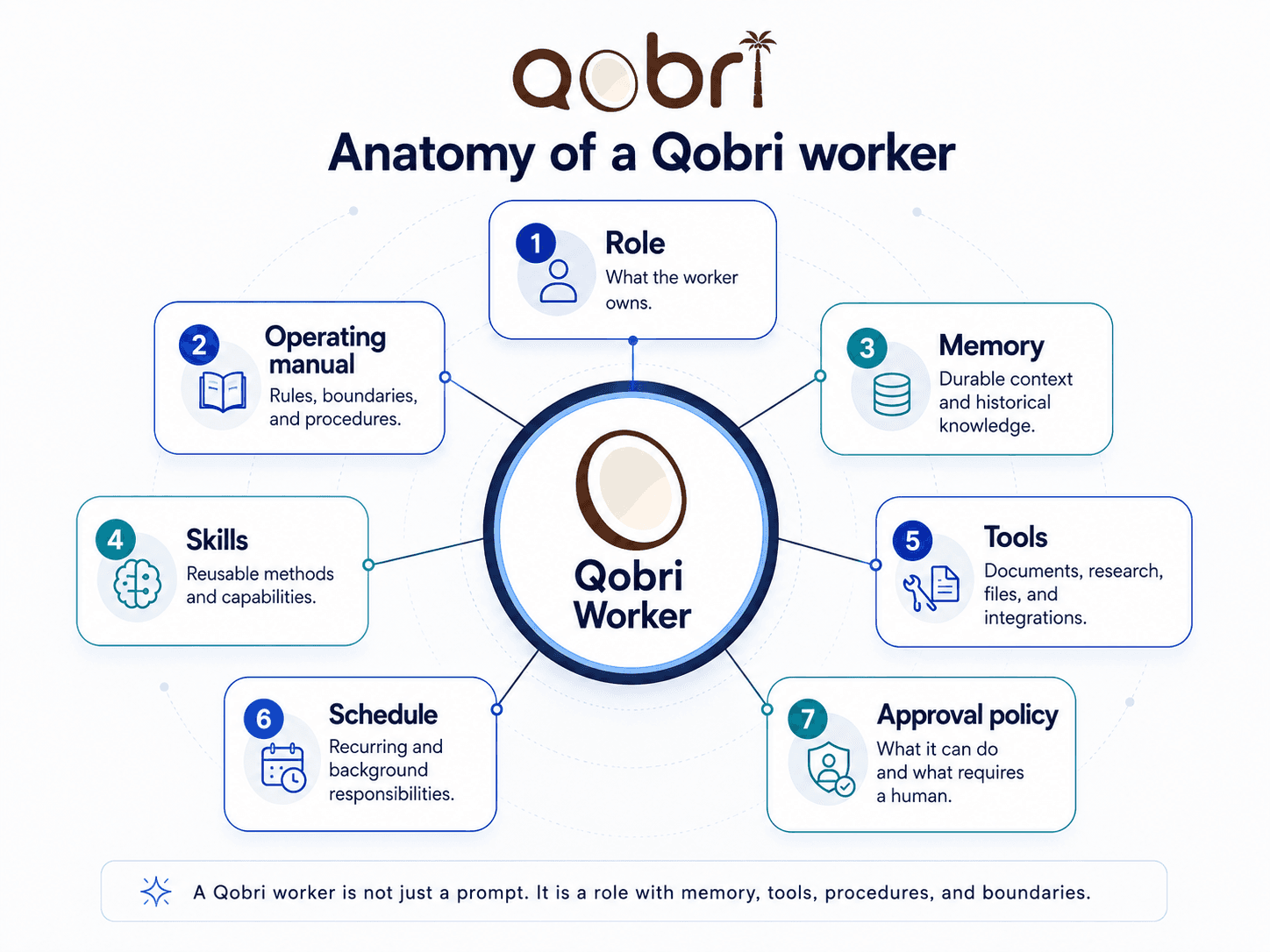
Instead of presenting AI as a blank chat window, Qobri organizes intelligence into specialized workers. Each worker owns a clearly defined role, operating manual, memory space, and set of permitted capabilities. A worker might reconcile financial statements, monitor investments, prepare management reports, organize documents, research a subject, draft communications, or coordinate recurring operational work.
Users interact with these workers through one private console. They can start a conversation, attach files, select a working folder, review generated artifacts, inspect activity, manage memories and skills, and schedule recurring jobs. The result is a practical control plane for both interactive AI and background automation.
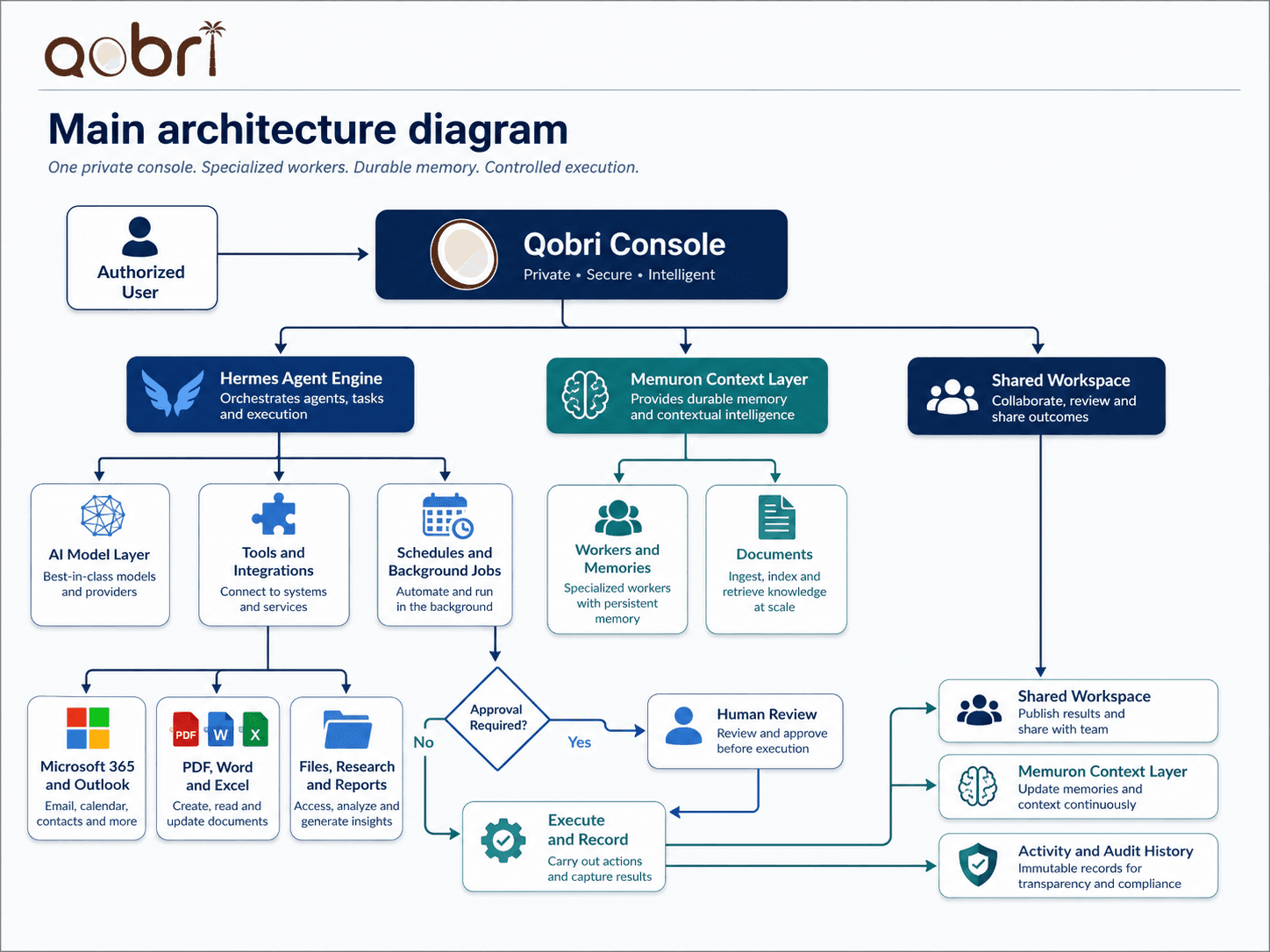
Hermes: the execution engine behind Qobri
Hermes is the agent execution layer that runs behind the Qobri interface. It manages model conversations, tool use, streaming responses, scheduled jobs, runtime sessions, and human-in-the-loop requests.
Qobri turns these capabilities into an operational product. The interface makes Hermes accessible without requiring users to work directly with command-line tools or internal runtime systems.
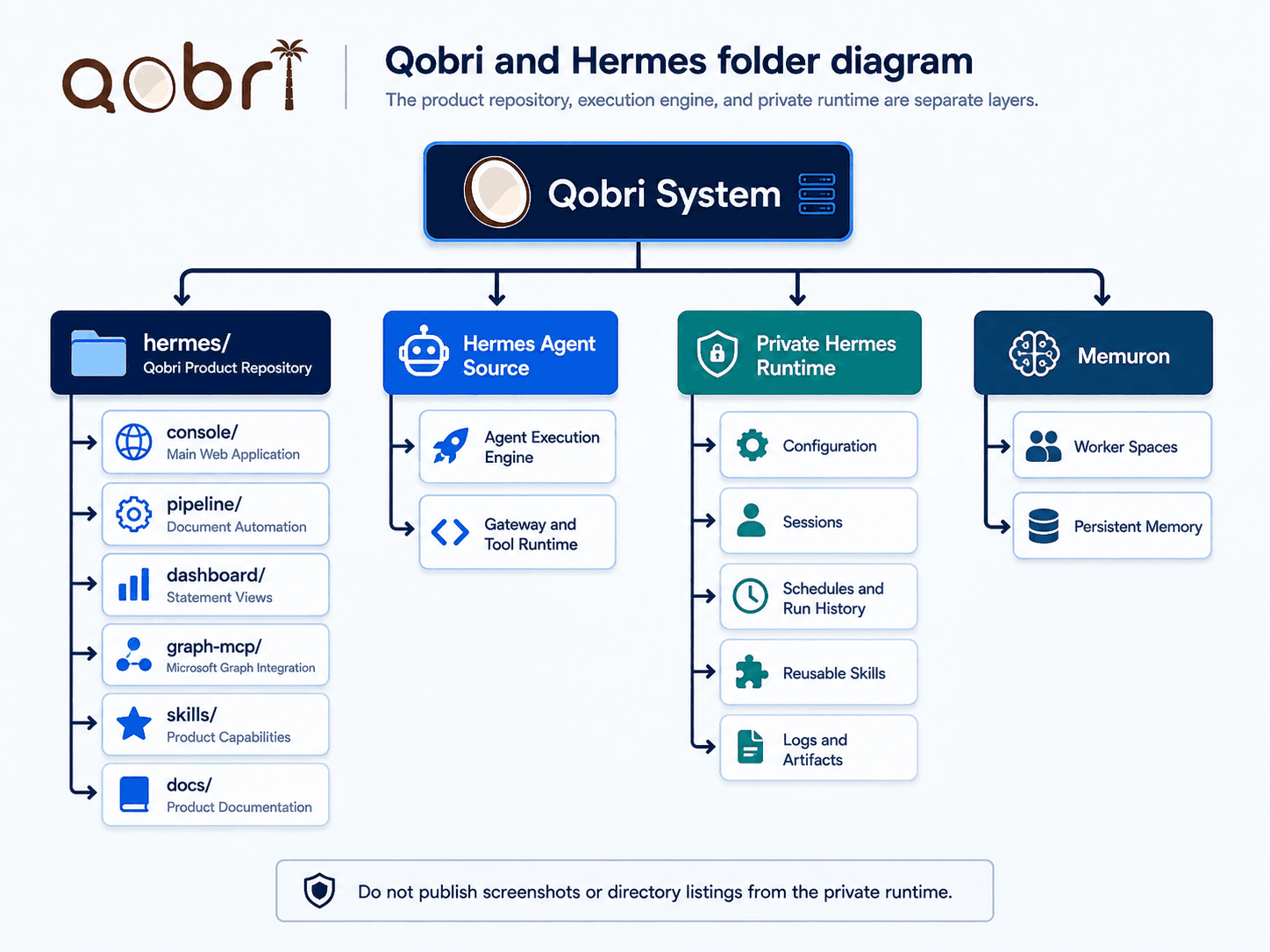
The Qobri product repository is maintained in the hermes/ folder and contains the principal application components:
console/— the main Qobri web application for chat, workers, schedules, memories, skills, activity, and work monitoring.pipeline/— automated document workflows, including Microsoft 365 and investment-statement processing.dashboard/— specialized views for statements and workflow history.graph-mcp/— Microsoft Graph integration capabilities.skills/— product-side reusable instructions and capabilities.docs/— operating, integration, and product documentation.
This product folder is distinct from the Hermes Agent source and runtime state. The Agent source provides the execution engine, while the private .hermes runtime contains configuration, sessions, schedules, logs, skills, and working artifacts. Keeping product code, engine code, and live state separate makes the system easier to operate, secure, and maintain.
Memory that survives the conversation
Qobri uses Memuron as its persistent context layer. In Qobri, an enabled Memuron space becomes a worker. The space contains the worker’s identity, operating instructions, memories, and supporting documents.
This creates an important distinction:
Worker
An ongoing role with responsibilities and long-term context.
Memory
A durable fact, decision, relationship, status, or historical record.
Skill
A reusable capability or procedure that workers can apply.
Because these elements are separated, operating instructions can evolve without erasing historical knowledge, while reusable skills can serve multiple workers.
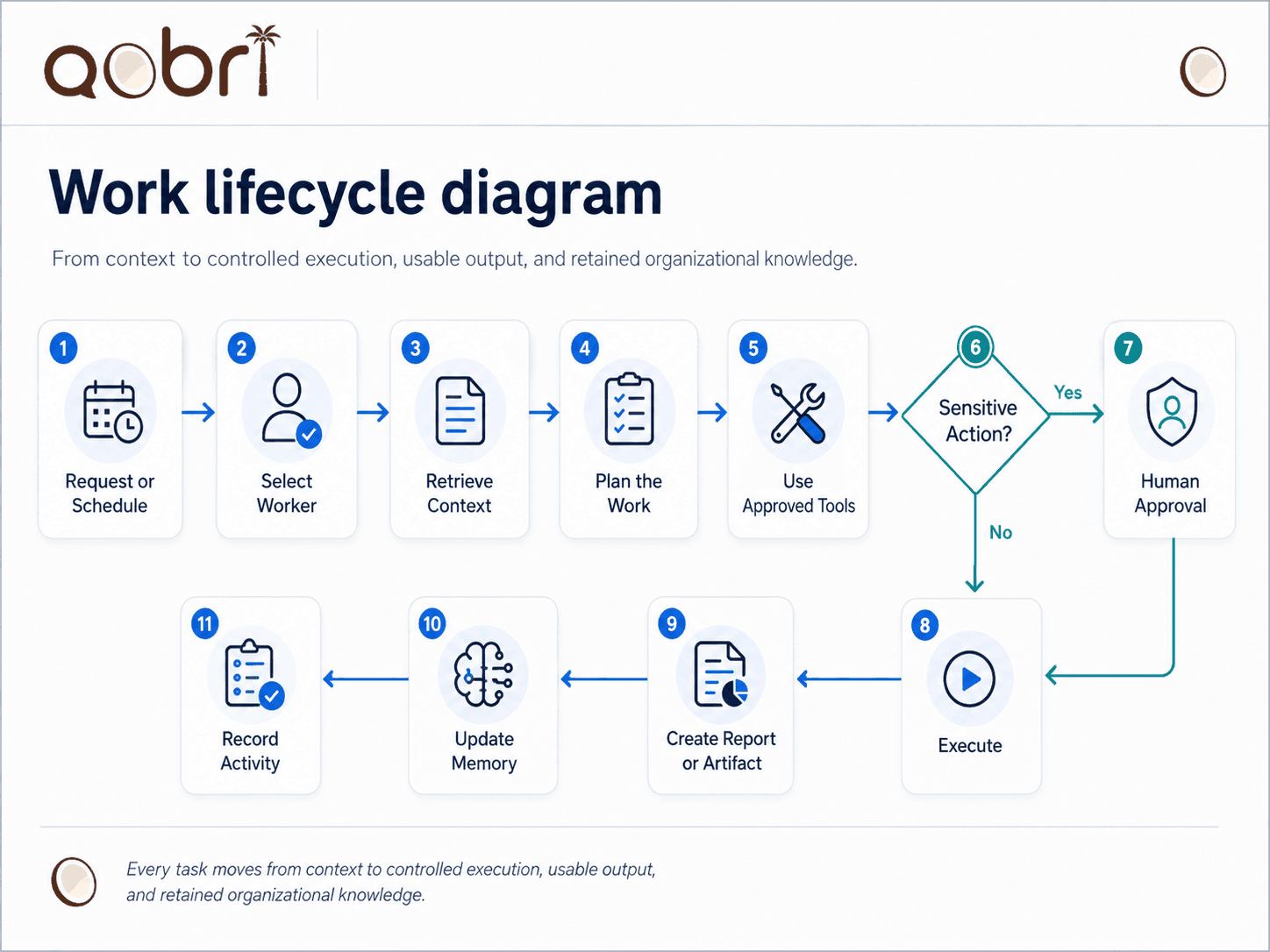
From conversation to completed work
Qobri supports more than chat. Work can begin with a user request, an uploaded document, a monitored folder, or a schedule. Hermes coordinates the selected worker and tools; Memuron supplies relevant context; Qobri streams progress and presents the resulting files, reports, or decisions.
Scheduled jobs can retrieve current worker instructions every time they run, process new inputs, save outputs to controlled destinations, and preserve execution history. Human-readable working files can be synchronized with an authorized Microsoft 365 or SharePoint workspace without mixing them with credentials or private runtime state.
For sensitive operations, Qobri keeps people in control. Workers can research, calculate, reconcile, organize, and draft. Actions such as sending confidential information, changing authoritative rules, deleting important files, or deploying material changes can be routed through an approval step. Financial transactions, investment execution, and final legal or tax decisions remain human responsibilities.
Private by design
Qobri is deployed as a private appliance rather than a public, open-access application. Services run with restricted privileges, internal databases avoid unnecessary network exposure, and remote access is protected through an identity-aware private network. Monitoring, backups, health checks, audit trails, and controlled deployment procedures support dependable operation.
Qobri’s central idea is simple: AI becomes significantly more useful when it is given structure. Roles provide accountability. Memory provides continuity. Skills provide repeatability. Hermes provides execution. Memuron provides durable context. Human approval provides control.
Together, they turn isolated AI interactions into an operating system for real work.
Qobri transforms AI from a conversation into a capable, accountable and continuously improving digital workforce.